
Cut Through Concrete: Cross Laminated Timber

Updated: Mar 2
The Case for CLT in Israel's Stalled Building Sector
When bureaucracy slows every phase of construction, the only rational move is to reimagine what we build with — and how fast it can go up.

Israel's construction industry is caught in a paradox familiar to any architect who has worked here: the demand for housing is urgent, the land is scarce, and yet the machinery of planning and permitting moves at a pace that would embarrass a slower civilization. Permits drag. Committees deliberate. Appeals accumulate. By the time a shovel enters the ground, the project has already bled months — sometimes years — from its timeline and budget.
The conventional response has been to push harder within the same system: lobby for faster approvals, hire more expediters, pad schedules with contingency. But there is another lever we are barely touching. What if the construction phase itself — the part we actually control — became radically faster, leaner, and more precise? What if the material we built with compressed weeks of on-site work into days?
This is not a hypothetical. It is the promise of Cross-Laminated Timber, and it is time Israel took it seriously.
"We cannot fix the permit office. But we can change what happens the moment the permit lands."
The Bureaucratic Bottleneck Is Real — But It's Not the Only Problem
Let us be clear-eyed about where the delays come from. The Israeli building permit process involves multiple layers of municipal, regional, and national review — planning committees (va'adot), environmental assessments, infrastructure approvals, and coordination between bodies that rarely speak to each other efficiently. Average permit timelines for mid-size residential projects regularly exceed 3–5 years in complex urban zones.
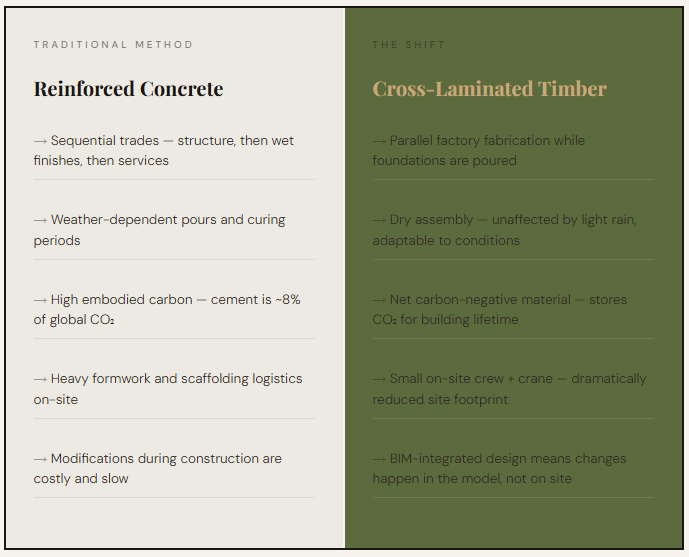
But here is what gets lost in that frustration: once the permit exists, the construction site itself is often its own theatre of inefficiency. Concrete pours depend on weather windows. Formwork has to cure. Coordination between trades creates cascading delays. Wet processes demand dry conditions. We have normalised a construction workflow that is fundamentally slow, and we treat it as inevitable — because for reinforced concrete and masonry, it largely is.
30% Faster construction time with CLT vs. conventional
RC frames
~75% Reduction in on-site construction waste
reported in CLT projects
1 tonne Of CO₂ stored per cubic metre of CLT over the building's lifetime
What Is CLT, and Why Does It Matter Here?
Cross-Laminated Timber is an engineered wood product made by layering boards at perpendicular angles, bonding them under pressure into large, dimensionally stable panels. The result is a structural material of remarkable rigidity and strength — capable of forming floors, walls, and roofs for buildings up to eight or ten storeys, with a fire performance that surprises those who assume wood burns easily (it chars predictably and maintains structural integrity far longer than exposed steel).

The critical shift CLT enables is the move from a wet, sequential, site-dependent process to a dry, parallel, factory-controlled one. Design decisions — the precise geometry of every panel, every penetration, every connection — are made digitally and fabricated off-site. When panels arrive at the building site, they are assembled, not constructed. A skilled team with a crane can erect a floor plate in a single day.

"In a country where the permit is the bottleneck, the construction phase should be a sprint, not a crawl. CLT turns structure into logistics."
The Israeli Context: Why Now?
Several forces are converging that make this an unusually timely conversation for Israel's building sector.
First, there is the housing crisis. Demand for residential units in the metropolitan rings of Tel Aviv, Jerusalem, and Haifa consistently outstrips supply. The government's TAMA 38 and urban renewal programmes have added layers of planning complexity without necessarily accelerating delivery. Any technology that compresses construction timelines has direct political and economic value.
Second, Israel's engineering culture is technically sophisticated and risk-tolerant in ways that ought to make CLT adoption easier than in more conservative markets. The country has a strong tradition of prefabrication — a legacy partly of early statehood construction urgency — and the leap from precast concrete to prefabricated timber panels is conceptually accessible to a generation of engineers already familiar with off-site thinking.
Third, sustainability requirements are tightening. The Israeli Standards Institute and the Ministry of Construction and Housing are under increasing pressure to align with European green building norms. CLT's carbon story — sequestered carbon locked into the building fabric — is a genuine differentiator at a time when embodied carbon is entering the regulatory conversation.
The Barriers Are Real — But They Are Not Insurmountable
To be serious about CLT in Israel, we have to acknowledge the obstacles. Israel does not yet have a domestic CLT manufacturing industry. Panels would currently need to be imported from Austria, Germany, or Scandinavia — which adds lead time, logistics cost, and supply chain complexity. This is not a trivial concern in a region with port dependencies and geopolitical exposure.
Israeli structural engineering codes also lag behind European Eurocodes in their treatment of timber as a primary structural material. Engineers here are trained on concrete and steel; CLT requires reskilling and a willingness to engage with a different structural logic. And the fire engineering community will need to develop local precedents — the char-rate calculations and compartmentalisation approaches that are routine in Zurich and London are not yet embedded in Israeli practice.
Yet all of these are learnable problems. The Austrian timber industry has spent thirty years building the knowledge base, training the engineers, and lobbying for code reform. Israel could compress that timeline significantly by treating CLT adoption as a strategic infrastructure priority rather than an ad-hoc market experiment.
A Shift in Thinking Before a Shift in Material
The deeper argument here is not just about CLT. It is about what we assume construction is allowed to be. For decades, Israeli architecture and construction have operated within a material orthodoxy defined by reinforced concrete: its weight, its permanence, its thermal mass in the Mediterranean climate, its familiarity to every contractor and municipality in the country. That orthodoxy is not wrong — concrete has served us well — but it has calcified into a default that we rarely question.
The permit system moves slowly because the system moves slowly. We cannot fix that today. But we can change our posture toward the construction phase itself — treating it not as a slow accumulation of wet work, but as the deployment of a precision-manufactured system. CLT is the clearest current example of that shift, but the spirit of it extends further: towards hybrid timber-concrete systems, towards modular volumetric construction, towards a relationship with the factory that is as intimate as our current relationship with the site.
The architects and developers who begin building that knowledge now — who pilot a CLT residential project, who engage with European suppliers, who push for updated standards — will be positioned to move with unusual speed the moment a permit lands on their desk. In a sector defined by waiting, that speed is a profound competitive and social advantage.
The Invitation
If you are an architect, developer, engineer, or policymaker working in the Israeli building sector, this is the moment to engage seriously with mass timber. Visit a completed CLT building in Vienna or London. Request a sample panel. Attend a timber engineering course. The barrier is not technological — it is attitudinal. The material is ready. The question is whether we are.
The permit will come when it comes. Make sure you are ready to sprint.
A thought piece on the future of Israeli construction · Cross-Laminated Timber as a strategic material · Architecture & Theory


Comments